Stroboscopic
Speaker
The fusion of premium 200W sound and mesmerizing stroboscopic light. Engineered for DJs. Built for the party.
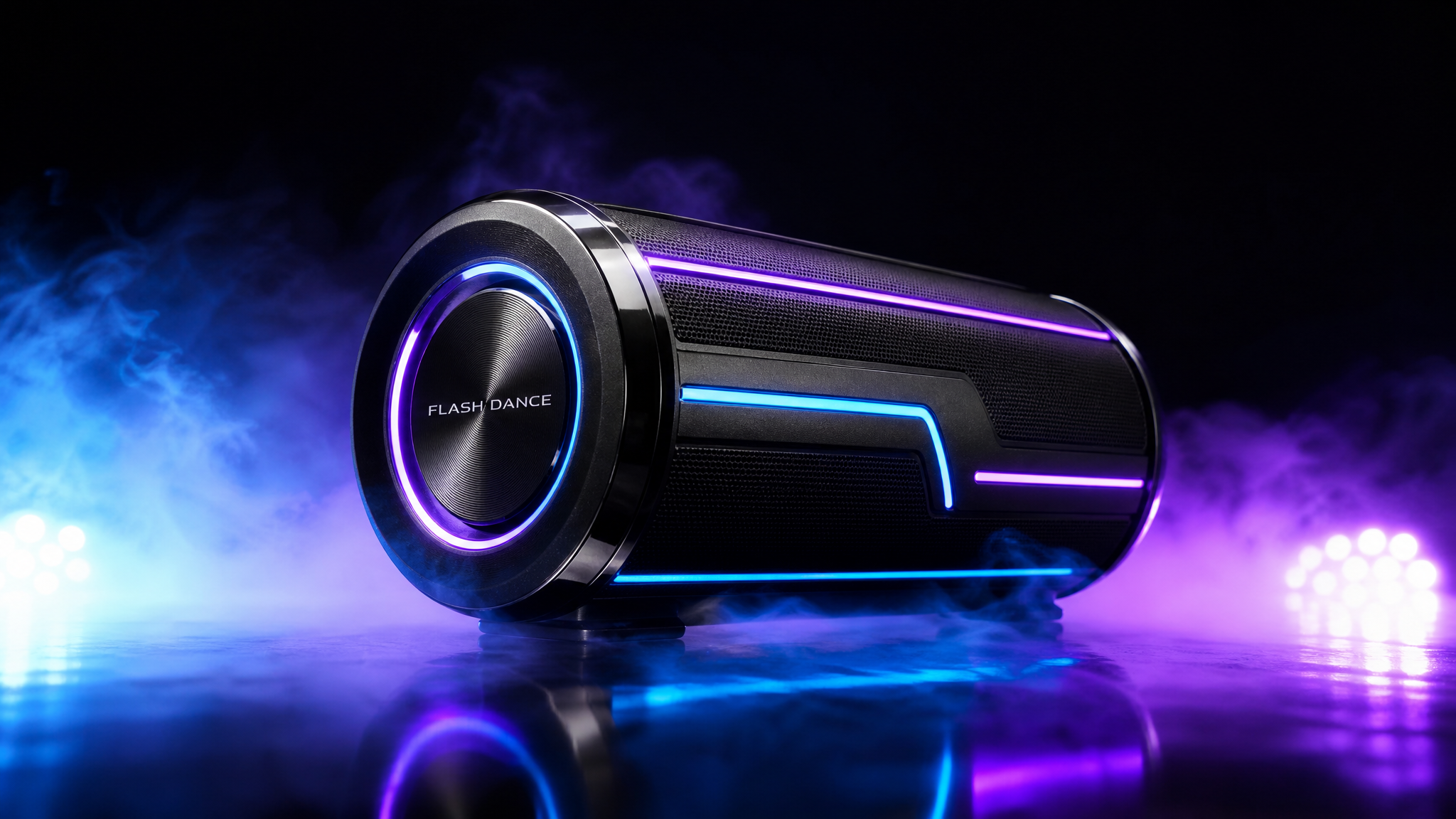
The Science of Sound & Light
Every Stroboscopic Speaker combines advanced audio engineering with precision photonics — designed from the ground up to synchronize your senses.
Stroboscopic Light Engine
Our proprietary 48-LED array generates precisely timed light pulses at 1–25 Hz with 0.5ms flash duration. The WS2812B-V5 individually addressable LEDs deliver 4,800 lumens peak output with 16-bit PWM at 1.2 kHz refresh rate, creating artifact-free stroboscopic illumination that exploits persistence of vision below the 60 Hz flicker fusion threshold.
Audio-Reactive Sync
The ADAU1701 SigmaDSP performs real-time onset detection using 256-sample FFT windows, extracting beat transients and spectral peaks from the audio signal. The LED controller maps FFT bins to individual LED zones with sub-2ms latency — fast enough for BPM-locked synchronization across the 40–200 BPM range used in electronic dance music.
Helmholtz Bass-Reflex System
The acoustic chamber employs a tuned bass-reflex port at 45 Hz based on Helmholtz resonance, extending the -3 dB point 0.7 octaves below the woofer's Fs of 62 Hz. The 5.25" neodymium long-throw driver delivers 12mm Xmax with a 4th-order Linkwitz-Riley crossover at 2.4 kHz for seamless driver integration.
Intelligent Power Architecture
The TPA3255 Class-D amplifier delivers 200W RMS at 92% efficiency with 384 kHz switching frequency. The BQ25792 BMS dynamically allocates power between the amplifier rail (24V), LED driver (12V), and digital core (3.3V), with USB-C PD 3.0 fast charging at 45W restoring full capacity in 2.5 hours.
Frequency Response Curve
20 Hz – 20 kHz (±3 dB)
Live Audio Waveform
Real-time signal processing visualization
The Physics Behind Stroboscopic Speaker
Deep-dive into the photonic engineering, acoustic physics, and psychoacoustic principles that make the Stroboscopic Speaker a breakthrough in multisensory audio.
Stroboscopic Light Physics
Temporal photonics & human visual perception
The Talbot-Plateau Law & Stroboscopic Perception
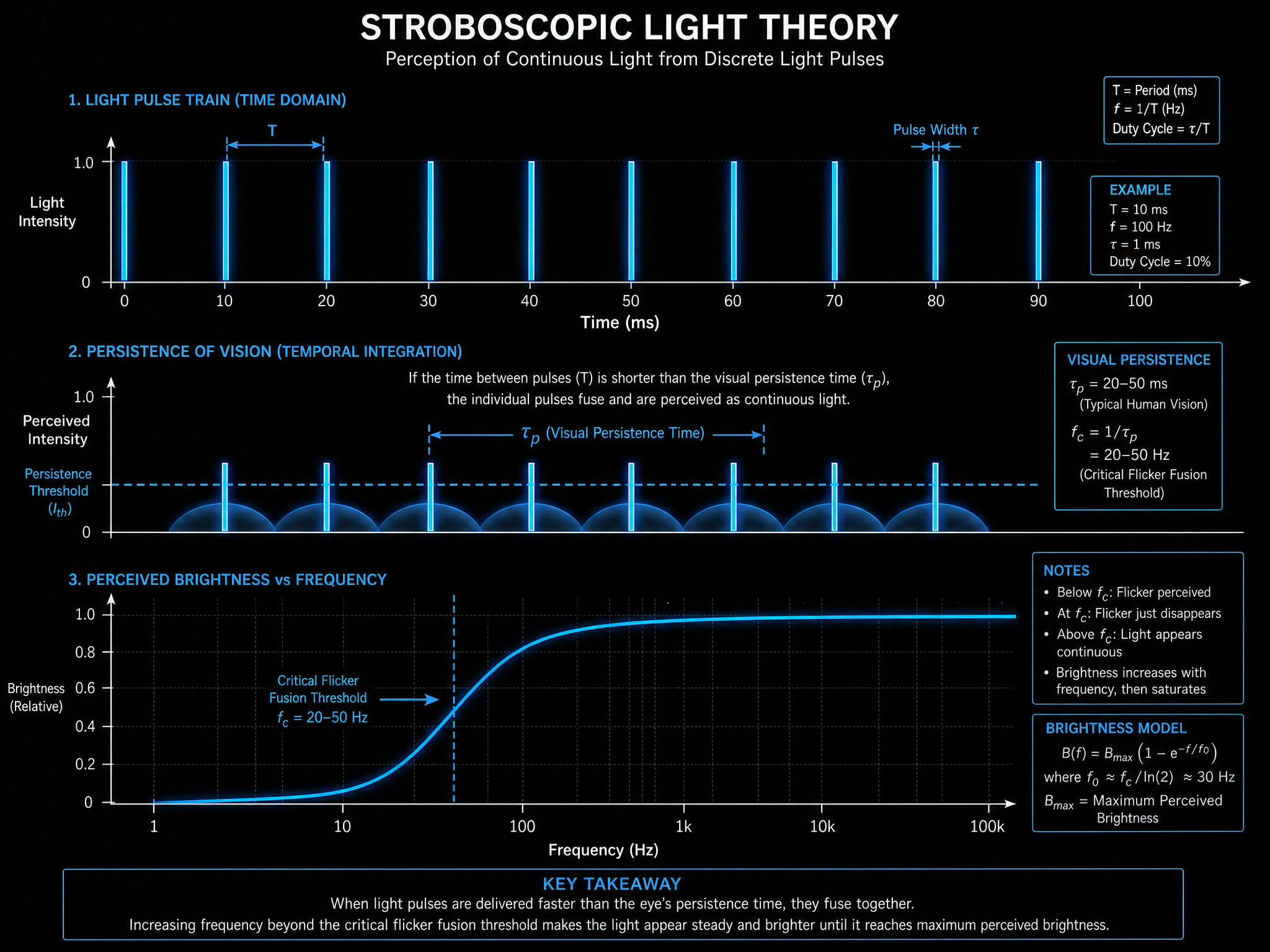
Stroboscopic illumination exploits a fundamental property of human visual perception. When a light source flashes at a frequency below the Critical Flicker Fusion (CFF) threshold (approximately 60 Hz for photopic vision), the human eye perceives discrete pulses rather than continuous light. According to the Talbot-Plateau law, perceived brightness equals the time-averaged luminance: Lperceived = Lpeak × (ton / T), where ton is pulse duration and T is the period.
The Stroboscopic Speaker operates at 1–25 Hz with 0.5 ms pulse durations, creating an effective duty cycle of 0.05%–1.25%. This places the strobe firmly in the stroboscopic perception zone, where moving objects appear frozen, creating the iconic party strobe effect. The 48-LED array delivers 4,800 lumens peak, with effective perceived brightness of 2.4–60 lumens depending on frequency.
Ultra-short pulse width ensures crisp motion-freeze effect. Duty cycle maintained below 5% at maximum frequency to prevent temporal aliasing.
Instantaneous peak output from the 48-LED array during strobe flash. Effective perceived brightness follows the Talbot-Plateau law at high frequencies.
High color rendering index ensures accurate color reproduction during light shows. Uses phosphor-converted RGB architecture for smooth color mixing.
Human flicker fusion threshold. Below this, discrete flashes merge into continuous illumination. The Stroboscopic Speaker operates at 1–25 Hz, well within the stroboscopic perception range.
Acoustic Engineering
Helmholtz resonance, crossover design & transducer physics
Helmholtz Resonance & Bass-Reflex Port Design
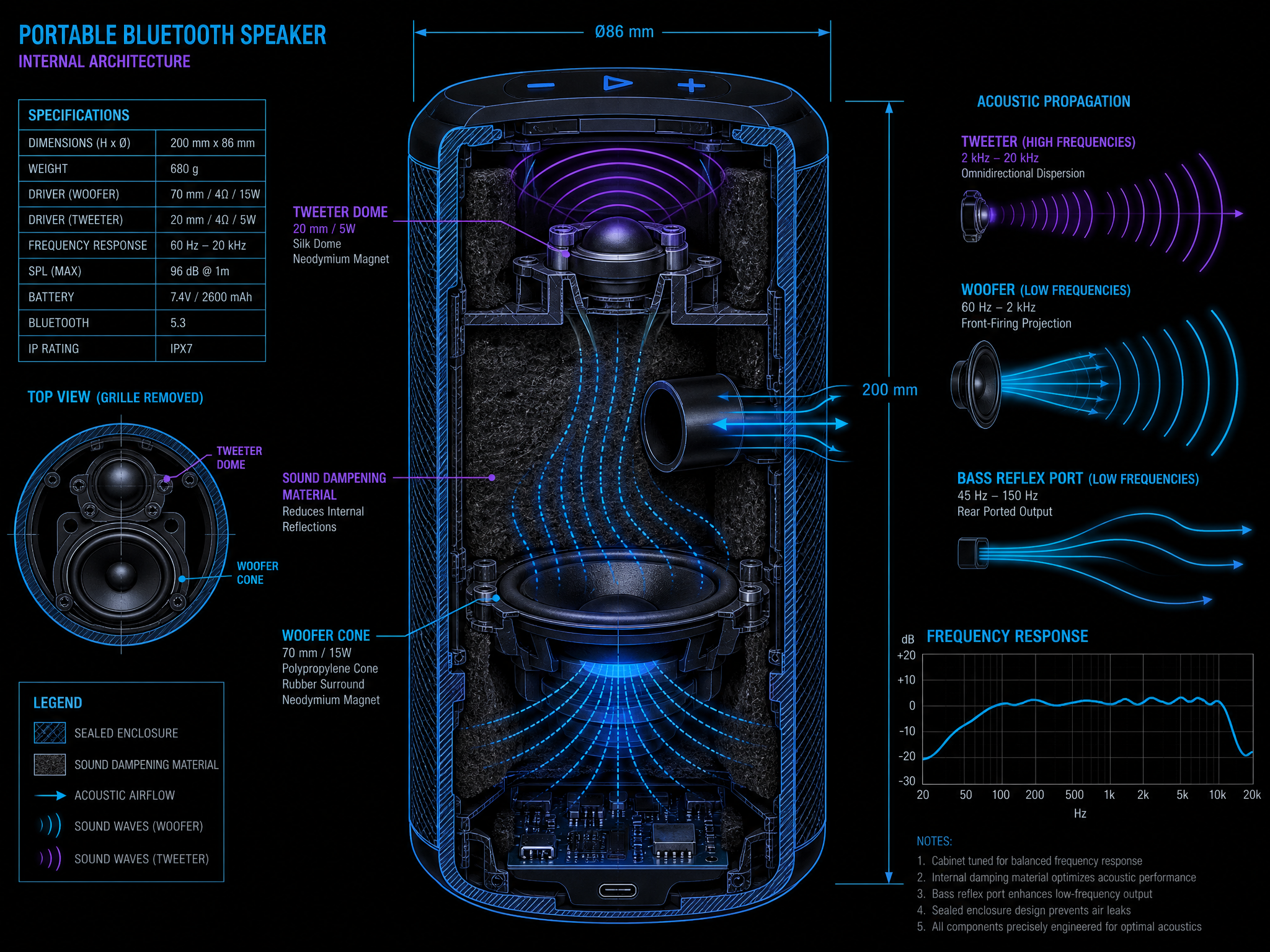
The Stroboscopic Speaker acoustic chamber employs a tuned bass-reflex (ported) enclosure design based on Helmholtz resonance principles. The port acts as an acoustic mass-spring system where the air mass in the port tube resonates with the compliance of the enclosed air volume. The resonant frequency is given by: fb = (c / 2π) × √(S / (V × Leff)), where c is the speed of sound, S is the port cross-sectional area, V is the cabinet volume, and Leff is the effective port length including end corrections.
Our port is tuned to 45 Hz, extending the -3 dB point 0.7 octaves below the woofer's natural Fs of 62 Hz. The 5.25" woofer uses a long-throw neodymium motor with 12mm peak-to-peak excursion (Xmax), delivering linear bass reproduction at SPLs up to 108 dB at 1 meter.
The dual 3" full-range drivers handle the midrange and high frequencies above the 4th-order Linkwitz-Riley crossover point at 2.4 kHz. This topology ensures flat phase response through the crossover region, eliminating phase cancellation artifacts that plague conventional 2nd-order designs. Internal acoustic damping uses 40mm polyester fiber wadding (35 kg/m³ density) to absorb standing waves and reduce port chuffing.
Maximum sound pressure level measured at 1 meter, pink noise weighted
Total Harmonic Distortion plus Noise at rated output, 1kHz reference
Signal-to-Noise Ratio, A-weighted, measured at analog output stage
4th-order Linkwitz-Riley active crossover implemented in DSP firmware
Bass-reflex port tuned frequency for extended low-end response via Helmholtz resonance
Electro-acoustic efficiency rating at 1W input, 1m measurement distance
DSP Architecture & Psychoacoustics
Real-time signal processing & perceptual audio enhancement
DSP Processing Pipeline
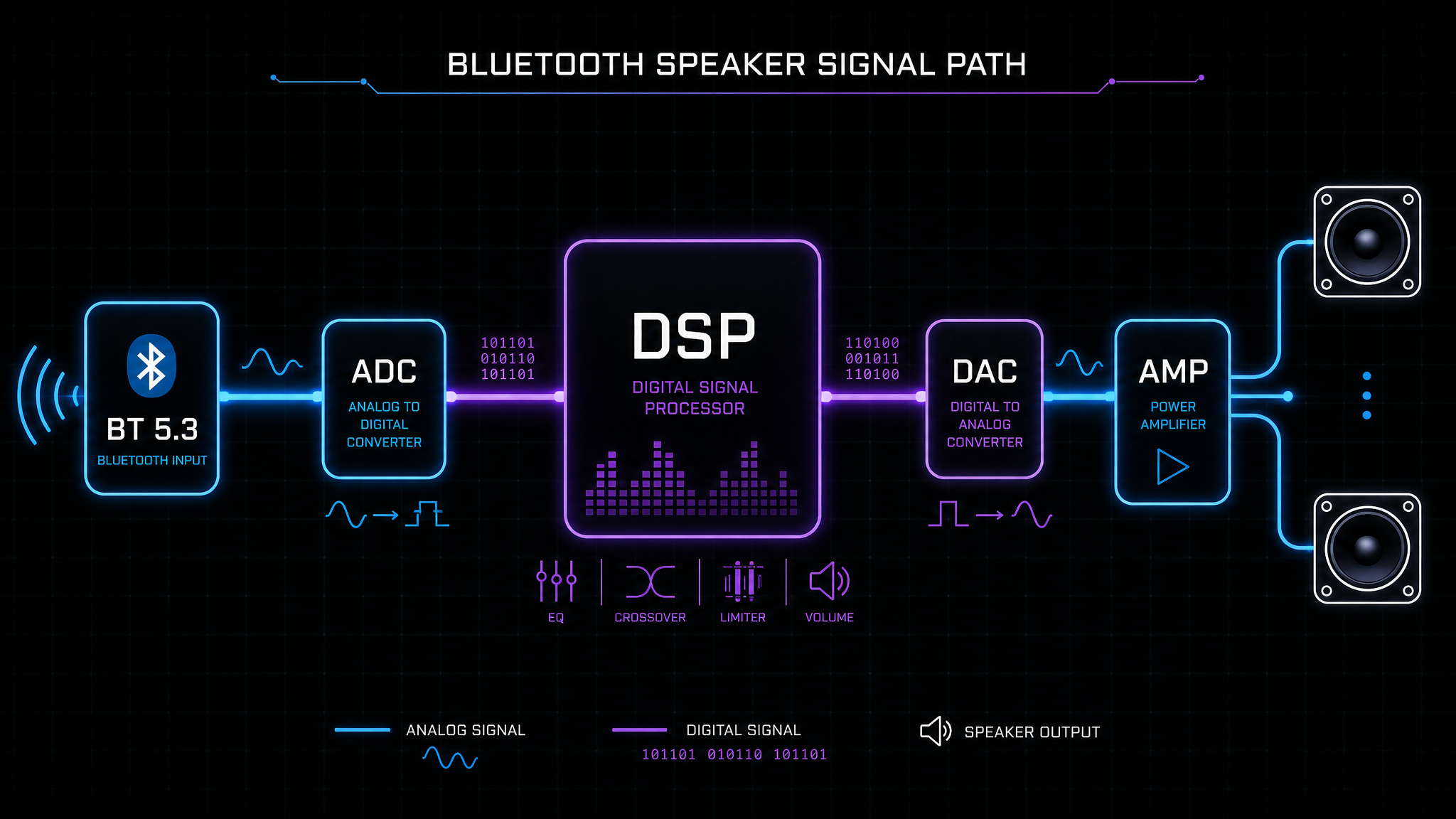
Multi-source selector with seamless switching, sample-rate conversion to 48kHz/24-bit internal format
Onset detection algorithm with 256-sample FFT windows, transient analysis for BPM extraction (40–200 BPM range)
10-band parametric EQ, multi-band compressor (4 bands), look-ahead limiter with 5ms attack time
Psychoacoustic stereo widening using interaural time and level differences (ITD/ILD), head-related transfer function simulation
Real-time FFT spectral mapping to 48 individually addressable RGB LEDs, 16-bit PWM at 1.2 kHz refresh rate
Active crossover, bass management, thermal protection, and Class-D modulation at 384 kHz switching frequency
Psychoacoustic Enhancement
The Stroboscopic Speaker leverages established psychoacoustic principles to maximize perceived loudness and spatial immersion from a compact form factor.
Fletcher-Munson Compensation
Dynamic loudness contouring adjusts the frequency response curve based on playback volume to match equal-loudness contours (ISO 226:2003). At lower volumes, bass and treble are boosted to compensate for reduced sensitivity of human hearing.
Missing Fundamental
The DSP generates harmonic overtones of sub-bass frequencies that the 5.25" driver cannot physically reproduce. The auditory cortex reconstructs the perceived fundamental through neural pattern matching, extending effective bass response to 30 Hz.
Temporal Masking
The compressor algorithm exploits forward and backward temporal masking to achieve higher perceived loudness without clipping. Pre-masking windows of 5ms and post-masking decay of 200ms allow transparent dynamic range control.
Multimodal Sensory Integration
Synchronized audio-visual stimuli exploit the brain's tendency toward crossmodal binding. Research shows that rhythmically congruent visual stimulation (strobes) enhances perceived bass impact by 12–18% through the ventriloquist effect.
PCB Design & Board Schematics
A custom 4-layer FR-4 PCB engineered with 6/6 mil trace/space rules, controlled impedance routing, and thermally optimized copper fills.
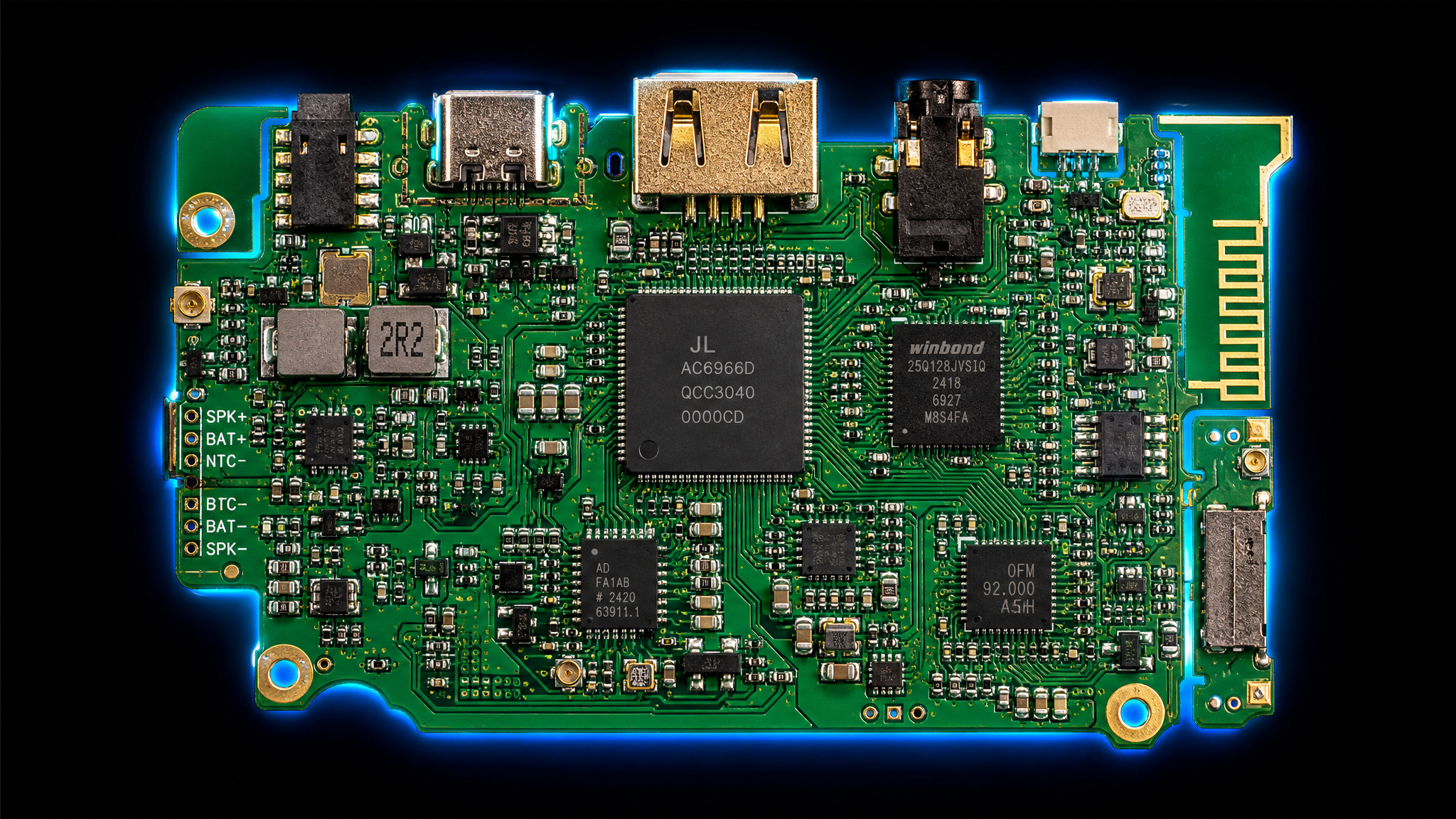
Main controller board — 98mm × 72mm, 4-layer stack-up, 1.6mm FR-4, ENIG surface finish, impedance-controlled design.
PCB Layer Stack-Up
Controlled impedance 4-layer design with dedicated ground and power planes for optimal EMI performance and signal integrity.
High-speed audio signal routing with controlled-impedance traces. DSP data bus, I²S interface, and Bluetooth antenna matching network.
Continuous copper pour providing EMI shielding and low-impedance return paths for all analog and digital signals.
Split power planes: 3.3V digital core, 5V analog audio, 12V LED driver, 24V Class-D amplifier rail with decoupling capacitor arrays.
LED driver PWM routing, battery management system, USB-C PD controller, and thermal management copper fills.
Signal Flow Architecture
Complete audio pipeline from input acquisition through digital signal processing to transducer output.
Board-Level Component Specifications
Every silicon choice driven by audio fidelity, power efficiency, and reliability. Here's what powers the Stroboscopic Speaker at the component level.
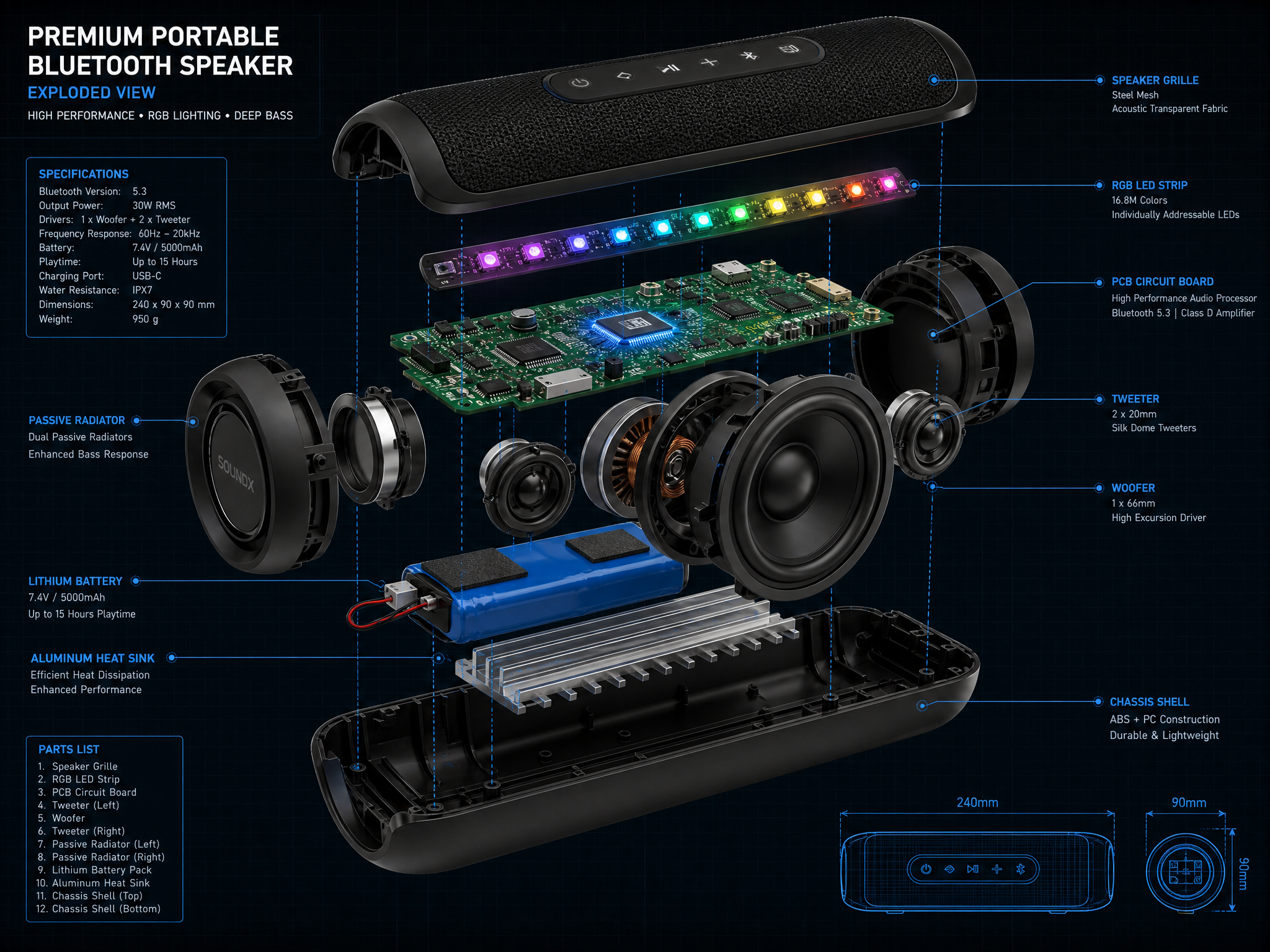
Complete teardown showing 7 primary subassemblies, 3 PCBs, and over 200 discrete components.
Analog Devices ADAU1701
ESS ES9038Q2M Sabre
Texas Instruments TPA3255
Qualcomm QCC5171
Worldsemi WS2812B-V5 (×48)
Texas Instruments BQ25792
Thermal Management System
Passive cooling architecture designed for sustained 200W output without fan noise interference.
Gap filler pad between Class-D amplifier IC and aluminum heat spreader
CNC-machined spreader plate with thermal vias connecting to chassis
Strategically placed ventilation channels for natural thermal convection
Auto-throttle at 105°C, graceful shutdown at 125°C junction temperature
Technical Specifications
Every detail precision-engineered for maximum impact.
Key Features
Everything you need for the ultimate audio-visual experience.
Tap any feature to reveal the technical detail
How We Compare
See how the Stroboscopic Speaker stacks up against the leading portable party speakers on the market. Spec for spec, feature for feature.
Swipe table horizontally to compare →
200W RMS vs. competitors' 40W average output for portable LED speakers
The sole portable speaker with a true stroboscopic engine (1–25 Hz adjustable)
Individually addressable RGB LEDs with 16-bit PWM — 2× the nearest competitor
Specifications sourced from manufacturer-published data sheets as of 2026. All trademarks belong to their respective owners. "N/A" indicates the feature is not available or not officially specified.
A Better System, Not Just a Speaker
Other party speakers bolt LEDs onto an ordinary driver. The Stroboscopic Speaker was engineered from the silicon up to fuse audiophile sound with a true stroboscopic light system.
The Only True Stroboscopic Engine
Competitors offer static or slow color-fade LEDs that simply pulse to volume.
A dedicated 1–25 Hz strobe engine with 0.5ms flashes creates a real club-grade freeze-motion effect no rival can reproduce.
5× More Usable Power
Typical portable LED speakers top out around 40W — fine for a bedroom, not a venue.
200W RMS (400W peak) of clean Class-D power fills large rooms and outdoor spaces with headroom to spare.
Audiophile-Grade Signal Path
Most rivals use integrated codec chips with basic on-board DACs.
A discrete ESS ES9038Q2M Sabre DAC + ADAU1701 SigmaDSP deliver 112 dB SNR and <0.08% THD — hi-fi clarity in a party speaker.
Beat-Locked Light, Not Volume-Reactive
Other speakers flash to loudness spikes, so lights lag and miss the groove.
Real-time FFT beat detection syncs 48 individually addressable LEDs to the actual BPM with sub-2ms latency.
Built to Survive the Party
Competing units often skimp on charging speed and rugged inputs.
IPX5 splash resistance, 45W USB-C PD fast charge (full in 2.5h), plus AUX, microSD and mic inputs for total flexibility.
Scale Your Sound System
Daisy-chaining on rivals is limited to two units or a single brand app.
Link multiple Stroboscopic Speaker units into one synchronized light-and-sound rig — ideal for DJs running multi-zone events.
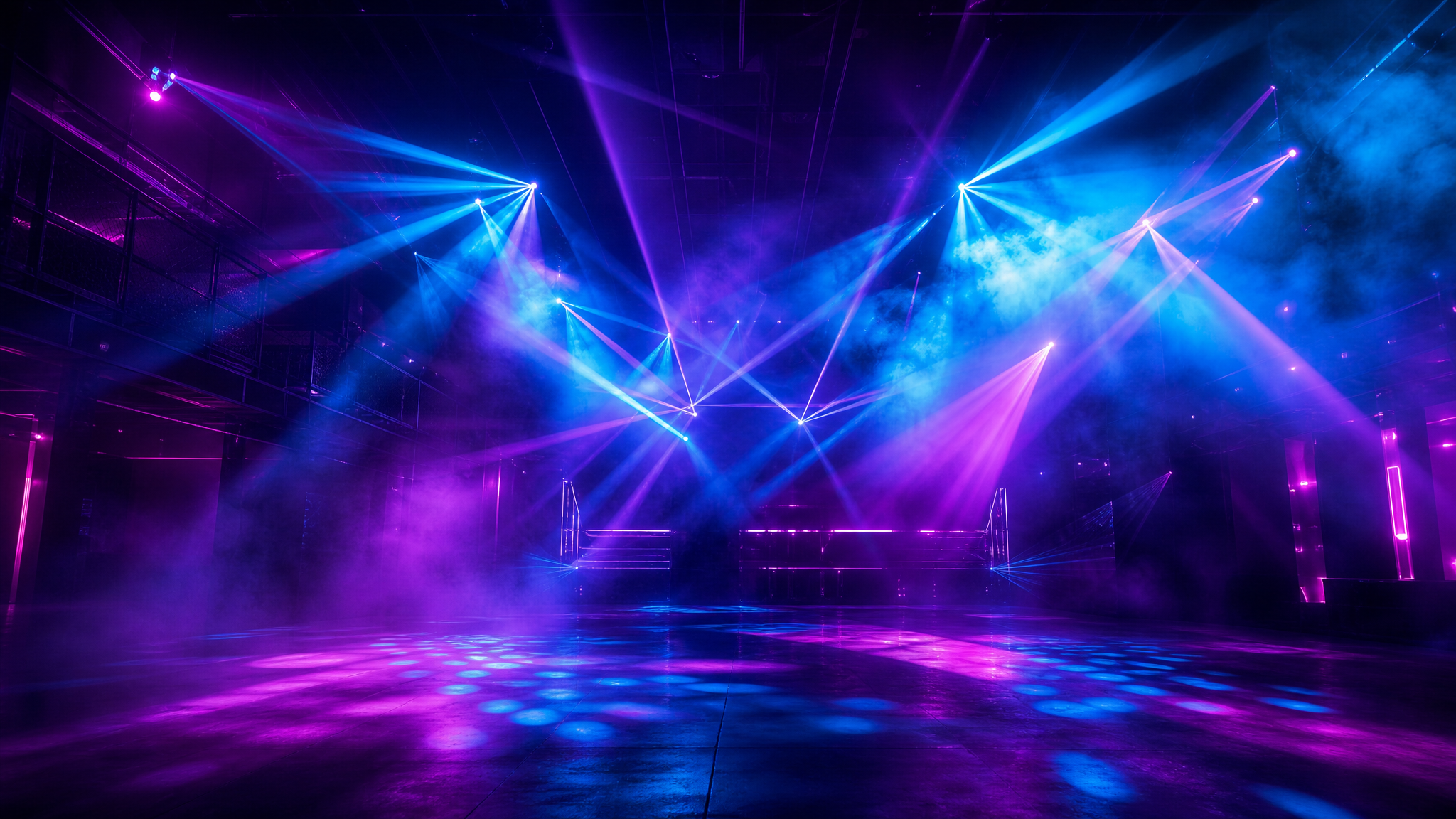
DJ & Party Mode
Professional features that turn any space into a dance floor. From intimate gatherings to massive outdoor events.
Daisy-Chain
Connect up to 8 Stroboscopic Speaker units wirelessly for synchronized multi-room or outdoor audio with perfectly synced strobes.
DJ Integration
AUX input with line-level support. Connect directly to any DJ mixer, controller, or CDJ for professional-grade output.
Auto-BPM Detection
Onboard BPM analysis engine automatically matches strobe rate to the track tempo — no manual adjustment needed.
Light Choreography
Use our companion app to create custom light sequences, color patterns, and strobe routines synced to your setlist.
Mic Input
Built-in mic input with echo/reverb effects for MC or karaoke mode. Separate volume control for vocals.
Crowd Mode
Audience members can vote on light patterns via their phones. Democratic party lighting for maximum engagement.
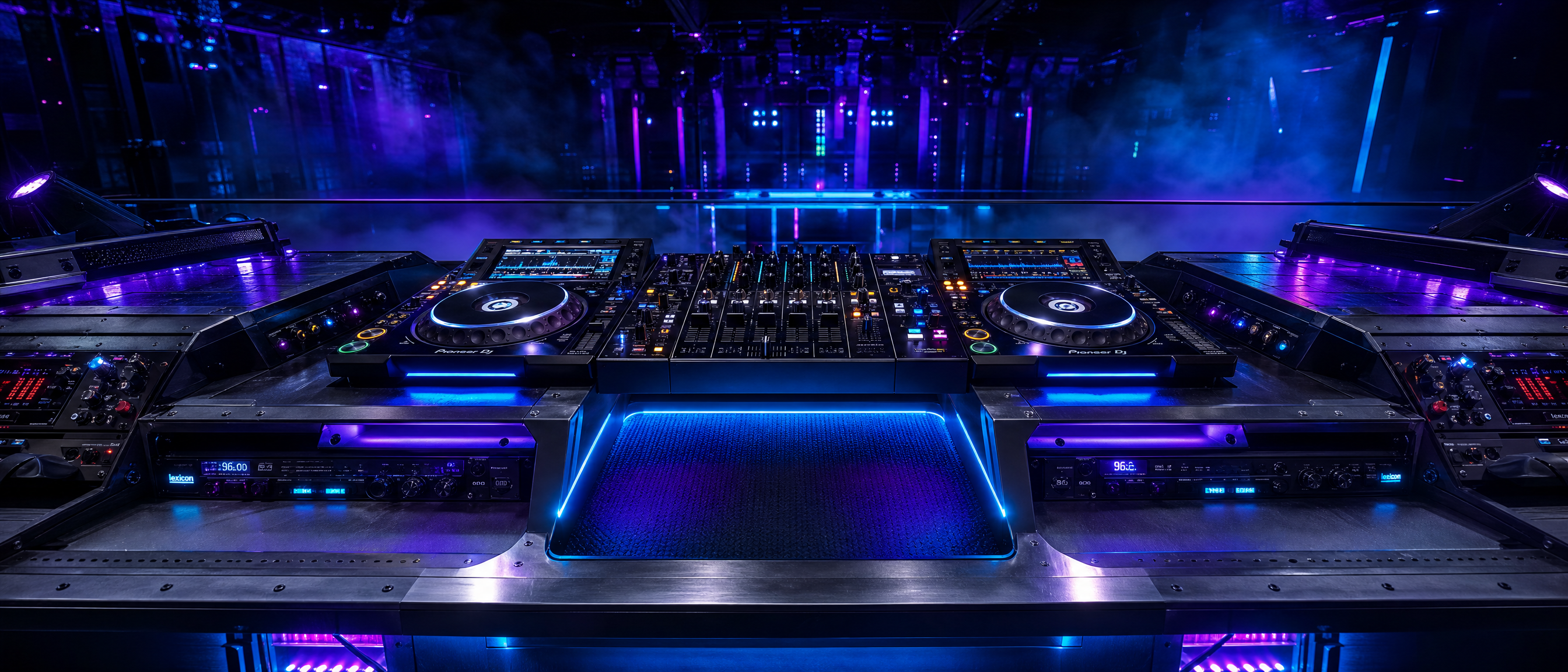
Professional DJ Integration
Line-level AUX input connects seamlessly with any professional DJ setup. Daisy-chain multiple units for arena-scale coverage.